Vector Tomography
- Accelerated electron beams interacting with a thin sample acquire phase shifts:
ϕ(r⊥)=ϕe(r⊥)+ϕm(r⊥)=ℏve∫LV(r⊥,z)dz−ℏe∫LA(r⊥,z)⋅dr - Can we reconstruct the 3D vector potential using tilt-series magnetic projections?
- Using Maxwell's equations, we can convert this to two scalar Radon transforms for the magnetic field
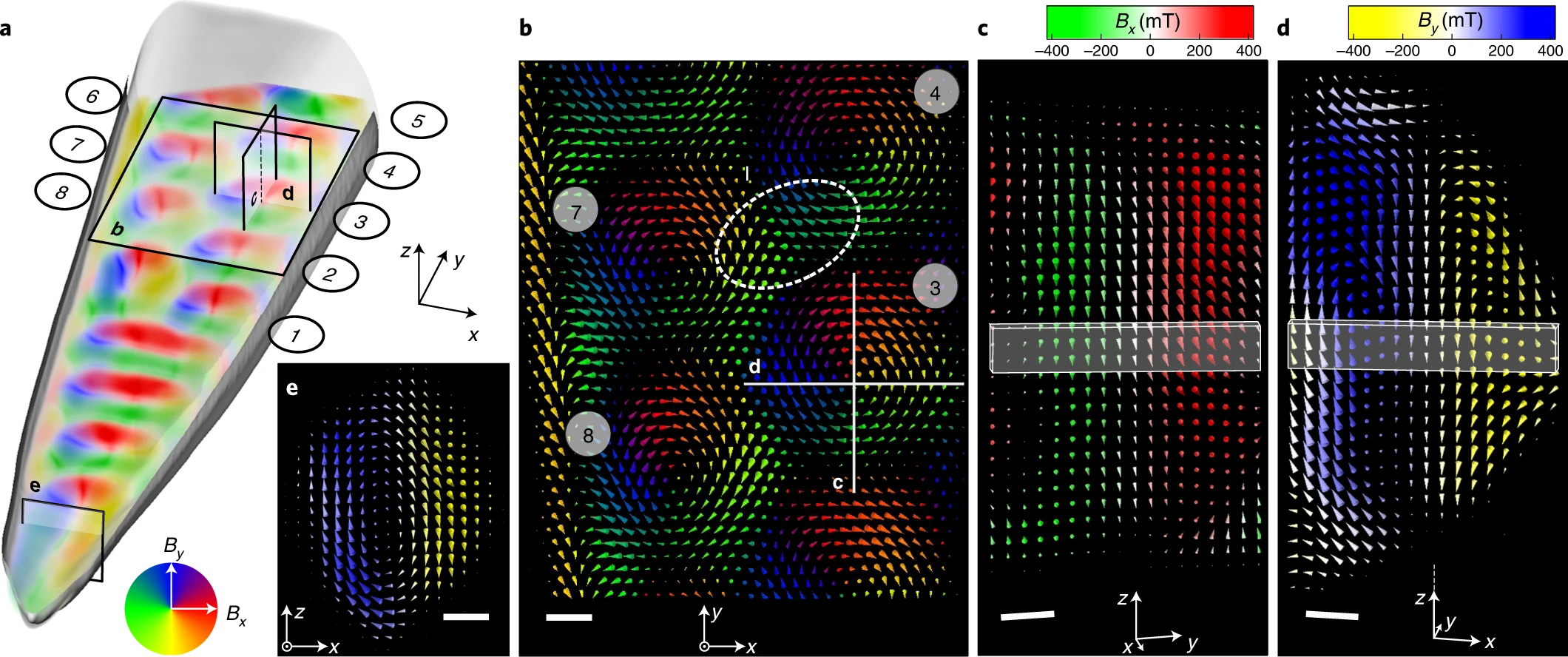 D Wolf et al., Nat. Nano. 17 250-255 (2022)
- How about using the tilt-series of 4D-STEM data directly?
- Yes, we can use vector ptychographic tomography